Tuesday, February 26, 2008

Five Essays for Interaction Designers

This is a warm up exercise for an updating of my somewhat out-of-date "top five books" list. These are my top five favorite essays about software design. Well, OK, to be accurate there are three essays and two interviews. The good news is that the three pieces from Winograd's Bringing Design to Software can all be read on the hci.stanford.edu Web site (sans figures though). For the others, you'll have to buy the books. Heck you ought to buy Bringing Design to Software anyway.

Here we go. Five essays for interaction designers...to inform, to inspire.

"A Software Design Manifesto", Mitch Kapor. In Bringing Design to Software (Winograd, 1996). This essay was first given as a talk at Esther Dyson's PC Forum in 1990, and it first appeared in print in Dr. Dobbs Journal in 1991. Kapor's essay represents a call to arms for a software design profession, and draws a strong parallel between software design and architecture.

"The Right Way to Think About Software Design", Theodor Holm Nelson. In The Art of Human-Computer Interface Design (Laurel, 1990). Ted Nelson is an early pioneer in Computer Supported Cooperative Work (CSCW) and information technology. He is credited with coining the terms "hypertext" and "hypermedia" in the 1960s, and along with Andries "Andy" van Dam he created the first hypertext system at Brown in the late 60s. Nelson's essay draws an analogy between software design and movie-making; interactivity is a key concept in both.

"The Designer's Stance", an interview with David Kelley by Bradley Hartfield. In Bringing Design to Software (Winograd, 1996). David Kelley is the founder of IDEO, which is arguably the world's premier design firm. This interview is a nice short introduction to Kelley's ideas, and should whet any designer's appetite for reading The Art of Innovation, written by David's brother Tom Kelley (IDEO's general manager).

"Cultures of Prototyping", Michael Schrage. In Bringing Design to Software (Winograd, 1996). Schrage is a well known consultant, writer, and researcher at the MIT Media Lab. This essay discusses the importance of prototyping to creativity and innovation, and draws on examples from the automotive and consumer electronics industries. This essay plays well with my opinion that software design needs to be much more like industrial design, and that we place far too much emphasis on "specs" as the primary deliverable of product designers, rather than multiple methods of articulating design and vision.

"Designing the PalmPilot: A Conversation with Rob Haitani", an interview with Rob Haitani by Eric Bergman. In Information Appliances and Beyond (Bergman, 2000). Rob Haitani was the Product Manager for the original PalmPilot, and is widely credited with being in charge of the design of the PalmOS user interface. As a Palm user from the very first PalmPilot, I'm an unabashed PalmOS fan. This interview, the longest reading so far at 20 pages, is a fascinating look at the design process and design for the small screen.

Sunday, February 24, 2008

Things That Are Important

"Things That Are Important" is a list of 5 principles that I have carried around in my Palm Pilot/Treo/Blackberry since the day in 1997 when they seemed to flow from my thoughts effortlessly. At least I think it was in 1997. I was about to transition from being an individual contributor to being a manager at Sun Microsystems, and I found myself thinking about my career, about what I thought was important, and how I wanted to manage my group. I like to believe that I have guided my career by these principles, and that I manage by them. Everyone who reports to me gets to hear them at least once.

1. Teamwork. This is about working for the good of the team, and thinking about the team. I use the term "team" in reference to all levels of the team - your local group, your larger organization, your division, all the way up to your corporation. All too often I have seen individuals act in their own self interests, rather than the interests of their group. Or groups act over the interests of their larger organizations or even their entire corporation. For people in my team, I expect them to watch each others' backs. This might be as simple as sharing information or giving a team member a "heads up" about something. Or it might be seeing a need and helping out. As for managers, we should always be aware of how our words and actions either foster or destroy a sense of team, both within our groups and among different groups.

2. Leverage. This is about making use of your work beyond the immediate purpose. Leverage is about making your organization more efficient. This is often played out in terms of taking lessons learned and sharing them with others, so that they don't have to learn what you already know the hard way. Sharing templates and tools and techniques that you have developed is another way of applying leverage to your work. One might call this just an aspect of teamwork, but I find it unique enough to deserve a place on my list.

3. Technical excellence. I am simply blown away, day in and day out, by the technical excellence displayed by the engineers with whom I work. As design professionals, it is important to also demonstrate a level of technical excellence and competence. There are two aspects of this. The first aspect is a level of technical competence regarding the software or device architecture upon which we are designing. This does not mean knowing the architecture as well as the engineers, but it does mean knowing enough to be an effective designer. You must have an understanding of what is possible, of what is difficult, of what is impossible. Without some level of technical competence, you will almost surely fail to establish a meaningful and productive relationship with your engineering counterparts. The second aspect is a level of technical excellence with respect to the domain for which you are designing. It doesn't matter whether you are designing, say, a programmer productivity tool, a financial application, a network or system management application, a social networking application, or a civil engineering application. You simply cannot be an effective designer without some level of technical competence in the application's "domain space."

4. Attention to presentation and detail in everything we produce. We are design professionals, and everything we produce should speak to that. This does not mean spending an infinite amount of time on an infinite amount of detail. Not at all. But it does mean considering the audience for everything you produce, and producing it with an eye toward design. Think of it this way - it isn't just about the quality of your design ideas, but also the quality of how you convey them.

5. It's not just a job, it's a profession. I am extremely passionate about this principle. While I don't discount that there are some pure natural design geniuses, most of the rest of us are mere mortals. I have a masters degree in the field, and have spent two decades practicing and reading and learning my profession. As such I have little patience with those who seem to think they can click their heels three times and call themselves an interaction designer, or a usability engineer, or whatever - all without having the foggiest idea of fundamental human-computer interaction and design principles, or without having any familiarity with the body of knowledge, or with the important thought leaders of the field. And, frankly, this means more than simply browsing a couple of web sites every once in a while. Like all established professions, we stand on the shoulders of those who have gone before us. When I was in graduate school twenty-some-odd years ago the field was small enough that you could literally read the body of literature. This is no longer the case, but you darn well ought to be familiar with the major works, and you darn well ought to be actively staying in touch with the field though readings and publications, local professional networking groups, and other training opportunities. Another way to think of this is as using constant professional learning as a means of continual process improvement - of learning and getting inspired by others to continually improve yourself. (Which reminds me, I posted a "top 5 books" list to my web site several years ago, and it is in dire need of updating - maybe that will be my next bog post.)

There you have it. Five things that are important. Have you thought about your own career principles? Or maybe just as important, do you have any idea of what your manager thinks, and whether his or her principles are in concert with your principles?

Friday, February 22, 2008

Design is about articulating vision of what is to be

In my reading and conversations and thinking lately I keep coming around to this phrase: design is about articulating vision of what is to be.

I was struck by this thought several times yesterday, including late last night while reading a passage in Henry Dreyfuss' autobiography, Designing For People. Dreyfuss was, IMO, the most important industrial designer of the twentieth century. Among other things, he designed the Twentieth Century Limited locomotive, the classic John Deere tractor, the Honeywell circular wall thermostat, the classic Hoover vacuum cleaner, and perhaps most iconic of all, the Bell model 550 telephone (the classic desktop phone). It was Dreyfuss' passage about the model 550 that stuck me. Here are some snippets from a section that is about three or four pages long:

Toward this goal, we proceed slowly, discarding more innovations than we accept.

Every conceivable kind of handgrip was considered...     Laboratory and field tests by typical telephone users...pointed up advantages.

...the phone began to fall into shape. This is an easy way of stating that something like 2500 rough sketches were scrutinized and narrowed down to half a dozen...

It would serve no purpose to confound the reader with the infinite mass of statistical detail that had to be carefully studied, the suggested changes that were agreed upon, rejected, or modified, and the compromises effected between engineers and industrial designers. Inherent limitations dictated much of the design.

Our office was in turmoil for weeks over what was called the "ROH Battle" - receiver off hook...

Sketches were made of all these variations, then accurate layout drawings. These were followed by full-size "breadboard models" of the components. When several designs appeared likely, they were modeled in clay, which can be easily modified as ideas develop. Later they were cast in plaster, sculptured and lacquered. This high polish was important so that the model could be analyzed for light reflection that might prove annoying or tiring. Some were equipped with mock components such as handset dials, cords, and number plates to simulate the finished product. When all decisions were made, a bronze master was made of the final design.

Is this any different than what those of us in software product design do, other than we don't work in the physical realm but in the software realm? I think not. All of these things ring true - the discarded ideas, the formative testing, the endless sketches and detail, the interaction between developers and designers, the inherent limitations of the software architecture, and the weeks of turmoil over thorny design problems.

And what Dreyfuss is describing, to me, is the many different ways of articulating vision of what is to be, every step of the way.

There's a side topic here too, about the role of "specs." Too many software organizations, I think, confuse design with "writing the spec." I think design is all of those other ways of articulating the vision of what is to be, each one reducing uncertainty and answering questions and focusing the idea. Then you write the spec, if needed, when things are pretty well nailed down. Not unlike how the telephone bronze master wasn't made until all the decisions were made about the final design.

Wednesday, February 20, 2008

Google loves tomspine.com

I don't know what it is about it, but Google just loves tomspine.com in its search results. Maybe it is because my site has been up for a long time. I just checked the Wayback Machine and found that I must have set up my domain late in 2003, although I know I first set up a site several years before that via my cable provider. In any event, I'm constantly amazed at how often my site shows up in search results.

Today was a case in point. I received a mail message out of the blue from a guy named Jonathan in Hudson, NH. Jonathan is a patient of Dr. Wingate at Nashua Eye Associates and he is considering LASIK eye surgery.

Like any sane person, Jonathan was doing some research on the surgery and the doctor. He found my write up of having Dr. Wingate perform LASIK surgery on me in 2000, updated with follow ups in 2001 and 2004. Jonathan wondered how things have gone since then.

I was thrilled to be contacted, and told Jonathan that yes, I'm still very happy with my LASIK surgery. While I do now wear reading glasses (ahem, no cracks about middle age), I continue to have excellent vision and no negative side effects.

But I wondered just how Jonathan found my web site. I thought, hmmm, maybe he did a Google search on "Dr. Wingate lasik", so I tried that. Holy cr*p, the order of the search results blew me away. First result is, of course, a sponsored link for some LASIK vision center. But then the first "real" search result is my web site! I come up before Dr. Wingate's bio, before a Nashua Telegraph article, even before the Nashua Eye Associates web site! That astounds me.

But I love it. :-)

Monday, February 18, 2008

Gender and Design

Talk of gender issues and the high tech industry usually focuses on the glass ceiling - the dominance of men in the senior leadership positions of many high tech companies. But there is a growing awareness of the importance of gender considerations in the design of technology products. The headline article in the Business section of today's Boston Globe, titled "Tech's feminine side" is a high level introductory look at the issue.

I recently had the pleasure of speaking with Laura Beckwith, one of the researchers quoted in the Globe article. Laura, now working at Microsoft, researched computing and gender issues while obtaining a Ph.D. at Oregon State University. She looked at how the design of end-user computing environments, such as spreadsheet debugging tools, influenced performance differences across male and female users. I was fascinated to learn of her work, and found it fundamentally important. You can learn more about it here.

The very important bottom line is summed up in this quote by Laura in the Globe article:

"There's a possibility that if you don't consider gender when you're designing your software, you are unintentionally designing for one and not both genders."

Sunday, February 17, 2008

Two (count 'em, two!) Boston-area UPA meetings this week

For the moment I will put aside my rant that we have too many splinter groups in the greater Boston area - Boston CHI (formerly SIGCHI, and IMO the granddaddy of all of these upstarts), UPA Boston, NH UPA, Boston-IA, and IxDA Boston are just five - and I'm sure I'm forgetting one or two more.

Anyway, what is this post about? Oh, yea - this coming week we have both NH UPA and Boston UPA meetings.

The NH UPA meeting is on Tuesday night, February 19 at PixelMEDIA in Portsmouth, NH. The meeting will feature four 10-minute talks, one each by Chauncey Wilson (Autodesk), Shannon McHarg (H&R Block), Rebecca Richkus (Autodesk), and Margot Bloomstein (PixelMEDIA). Go Chauncey and Rebecca! See the NH UPA site for more info.

And Autodesk is again taking the spotlight on Thursday night, February 21, at the UPA Boston meeting. This one will be held at Autodesk in Waltham, MA, and the theme is a series of short talks about design and usability organized by Chauncey and the Autodesk Revit product design team. More info is available on the UPA Boston site.

I'll be at both meetings this week, cheering on the home team.

Saturday, February 16, 2008

Project Ticket Stub - 1988

This was a year for lots of Hot Tuna, David Bromberg, John Hartford, and the Dead...
Hot Tuna, March 26, 1988

Hot Tuna
The Stone Pony, Asbury Park, NJ
March 26, 1988

Acoustic and electric sets at the legendary Stone Pony. I think my ears are probably still ringing from the electric set. This show was just an added bonus for the Dead shows coming up in a few days...
Grateful Dead, March 30 and 31, 1988
         
Grateful Dead
Meadowlands Arena, East Rutherford, NJ
March 30 and 31, 1988

These were the first two of three shows played at the Meadowlands, and they were on Wednesday and Thursday nights. Why, I wonder, didn't we go to the Friday night show? That seems peculiar, and I have no recollection that would explain it.

Nothing stands out, other than this was the period where the band was doing Dear Mr. Fantasy > Hey Jude, and we got that on Thursday night. Both those songs were loads of fun, with Brent singing lead on Fantasy, and the crowd singing along on Hey Jude.
Grateful Dead, April 3, 1988
         
Grateful Dead
Hartford Civic Center, Hartford, CT
April 3, 1988

The Sunday night show in Hartford. If I remember it correctly, this was the show where Jerry's voice was completely shot. Painfully shot. This was the first of three shows in Hartford, and we were glad we were skipping the last two shows, and hoping he recovered by later in the week when the band hit Worcester...
Grateful Dead, April 7 and 9, 1988
         
Grateful Dead
The Centrum, Worcester, MA
April 7 and 9, 1988

Here again I went to only two of three shows. For some unknown reason I skipped the Friday night show. Perhaps it was cash flow?
Note the "Behind Stage" mark on the Thursday night ticket. The Dead were starting to get popular, touring behind the fairly successful "In The Dark" album and the band's only top 10 song, "Touch of Grey" Popularity - bummer.
John Hartford, April 23, 1988
         
John Hartford
Nashua Center for the Arts, Nashua, NH
April 23, 1988

No doubt about it, this is a top-10 all time concert.

Memories of this concert are strong, owning in no small part to the WEVO-FM live broadcast of the show. Since I was going to the concert, I took my trusty Nakamichi BX-100 cassette deck over to my friend Chuck's house, and set Chuck up so all he had to do with hit the record button. Chuck did a fine job recording the show for me.

In October, 2002 I transferred the cassette masters to computer WAV files, and created lossless SHN files. These SHN files are now widely circulated among Hartford fans and collectors, and in fact bt.etree.org has an active torrent seed of the show right now.

WEVO-FM itself occassionally plays some cuts from my recording during the Sunday night Folk Show. Although WEVO did quite a few live broadcasts from the Nashua Center for the Arts, it seems they never recorded them (or the tapes are lost in somebody's private stash). So after I did the transfer from cassette I gave a copy of the resulting CDs to Kate McNally, the Folk Show DJ. She was really happy to receive it, and every now and then I hear her play a cut from the show.
John had the respectful Nashua audience in the palm of his hand. The sing along portions are particularly great on the recording. WEVO must have had some mics on the audience, and the result is excellent.

Chuck Berry and Friends, May 7, 1988
         
Chuck Berry and Friends
Cheshire Fairgrounds, Swanzey, NH
May 7, 1988

This was an all afternoon show at the outdoor fairgrounds in Swanzey, NH. It was a wonderful late spring day in New Hampshire. I don't remember the exact order of the show, but I think it went:
  • Carl Perkins
  • Johnny Rivers
  • Roy Orbison
  • James Brown
  • Chuck Berry
The highlight of the show was, without a doubt, Roy Orbison. I feel very fortunate to have seen him. Little did we even think at the time that Roy would be gone by the end of the year, dead at age 52 from a heart attack.

The lowlight of the show was James Brown. We were all very much looking forward to seeing the Godfather of Soul, but this wasn't the night. I don't know if he was just drunk or high on drugs, but he was out of it. He could barely stand up, and had to be, uh, assisted on stage by two of his flunkies. His performance, if you could call it that, was short and just plain stunk.
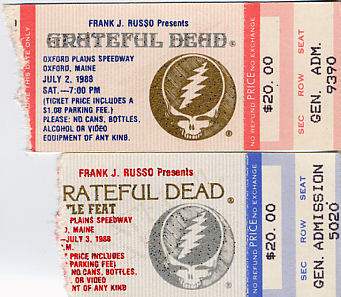
Grateful Dead, July 2 and 3, 1988
         
Grateful Dead
Oxford Plains Speedway, Oxford, ME
July 2 and 3, 1988

The weekend was probably the most fun I ever had in all my Dead shows. This setting, rural Maine, was the polar opposite of all those very fun Dead shows at Madison Square Garden. We had a very large group of probably 20 or more all camping together next to a lake about a mile or two from the speedway. My Web site has this photo of a boat on the lake in fog that I took at the campground late one afternoon. It looks oh so peaceful, but behind the camera's view is the cacophony of tents and grills and music and dozens of happy campers.
I remember there was some amount of trepidation leading up to the weekend. If I recall correctly, a week or two before there was a heavy metal concert at the speedway, and things did not go well. Rowdy, drunken metal heads did some disrespectful things to the locals, and the result was predictable. Word spread, and both the Deadhead community and the locals were wary of what would happen when we arrived. No worries, though, for as the locals found out, Deadheads tended to be a mellow and peaceful bunch.

Funny, but one of my memory highlights is walking to the speedway for the shows. I'm pretty sure the cops closed the road leading up to the speedway to vehicle traffic. So I have this memory of this rural Maine state highway full of Deadheads as far as the eye could see, all walking to (and from) the show. Surreal.
Kingston Summer Jam, August 21, 1988
         
Kingston Summer Jam
Kingston Fairgrounds, Kingston, NH
August 21, 1988

This was an all-afternoon outdoor concert on the fairgrounds. I recall it was quite the low key and relaxed affair. The line up, in order as I recall it was:
  • Papa John Creech
  • David Bromberg (solo)
  • Max Creek
  • Rick Danko
  • Hot Tuna with David Bromberg
I'm really glad I got to see Papa John. I think that may be the only time I saw him. Or was he along on the Jefferson Airplane reunion tour in 1989? No, I don't think so, or I'd remember it.

Nonetheless, the highlight for me was the closing Hot Tuna Bromberg set. This was all acoustic, and sitting in chairs from left to right were David, Jorma, and Jack. Bromberg and Jorma together are, IMO, more than the sum of their parts, and this set mixed Bromberg tunes and Hot Tuna tunes together.
Bob Dylan, September 3, 1988
         
Bob Dylan
Riverfront Park, Manchester, NH
September 3, 1988

Riverfront Park! Ha! Some park. Riverfront Park was nothing more than an asphalt parking lot hemmed in by a number of the old mill buildings along the Merrimack River. This was also called Arms Park, and today there is a pretty strip of trees and grass in this area, just south of the Bridge Street bridge. Were there some buildings there that have since been torn down for parking? I really recall being hemmed in by brick buildings. You can imagine how good the sound wasn't.

I'm pretty sure the opening band was Timbuk3. Besides the venue, the only thing that really stands out about Dylan's set is a fair number of familiar songs that were almost completely unrecognizable, particularly "Girl From The North Country."
Eric Clapton, September 14, 1988
         
Eric Clapton
Great Woods Performing Arts Center, Mansfield, MA
September 14, 1988

Crap. I just don't remember this show. Nothing sticks out. Pretty easy to research it on the Web though - it was a Wednesday night, Mark Knopfler was part of the band, a pretty typical Clapton setlist ("Crossroads", "White Room", "After Midnight", and more), Knopfler did "Money for Nothing", encore was "Sunshine of Your Love." But I'm afraid there really aren't any memories that stand out.
Grateful Dead, September 16, 18, 19, 20, 22, and 23, 1988
         
Grateful Dead
Madison Square Garden, New York, NY
September 16, 18, 19, 20, 22, and 23, 1988

Here we go! A full week-plus of Dead at Madison Square Garden! Actually, the band's run at MSG started on the 14th, but I didn't see either that show or the show on the 15th. My run started on the Friday night show on the 16th.

Looking back now almost twenty years later, the week is just one long blur of Dead shows, and it is impossible to say "oh yea, and on the Tuesday night show they played 'Louie Louie'." Of course, they really did play "Louie Louie" on the Tuesday night show, but distinguishing that night from the other nights just isn't possible.
Grateful Dead, September 24, 1988
         
Grateful Dead & Friends
Madison Square Garden
September 24, 1989

Even though this is the next, and last, night in the MSG run, I am listing it as an individual entry. This night was special, and more than "just" another Dead show.
This was a benefit concert with proceeds going to Cultural Survival, Greenpeace, and the Rainforest Action Network. The concert was broadcast live on WNEW-FM in New York, and WMMR-FM in Philadelphia. Bruce Hornsby & The Range opened the show.

And then the real fun began with the Dead's two sets. We knew it was going to be a special night when three songs in former Rolling Stones guitar player Mick Taylor was on stage for "West L.A. Fadeaway" and "Little Red Rooster." The latter song, being a blues number, was perfect for Taylor. (Ah, I suppose West LA is sorta blues inspired as well.)

The rest of the first set was pretty straight forward, but the second set opened in a completely surprising way with Suzanne Vega on stage with an acoustic guitar and the band backing her on two of her own songs, "Chinese Bones" and "Neighborhood Girls." The surprises continued a couple of songs later when Daryl Hall and John Oates came out to play "Every Time You Go Away" and "What's Going On." Daryl Hall's lead vocals on "What's Going On" was particularly memorable, and the song rocked out. Drumz was notable for the inclusion of a bunch of folks, including Baba Olatunji.

Everybody was out for the encores, "Good Lovin'" and "Knocking On Heaven's Door" - Hornsby, Hall and Oates, Jack Casady (on bass, of course), Suzanne Vega, and Olatunji.
Without a doubt, this was the most unique Dead show I ever saw.
Hot Tuna, October 20, 1988
         
Hot Tuna
Raoul's Roadside Attraction, Portland, ME
October 20, 1988

The ticket says Jorma Kaukonen, but this really was acoustic Hot Tuna - Jorma and Jack Casady. Raoul's is a little hole in the wall sort of place, still running today, and for me the perfect type of venue for Jorma and Jack sitting down and playing their acoustic magic. A fine show.
David Bromberg, David Grisman, John Hartford, October 21, 1988
         
David Bromberg, The David Grisman Quartet, & John Hartford
Sanders Theatre, Harvard University, Cambridge, MA
October 21, 1988

It is impossible to not catch your breath in awe the first time you walk into Sanders Threatre. If you have never been there, this picture gives you a small sense of the its beauty. Deep rich wood, constructed with a detailed craftsmanship that simply isn't possible today. The acoustics of Sanders is phenomenal. It is absolutely one of my most favorite venues, and the only complaint I could ever have about it is that it can be rather cozy - there will be no space whatsoever between you and whomever is sitting next to you. Oh, and don't get stuck behind one of the support pillars.

For this show, John Hartford went first, then Grisman, and then Bromberg closed the show. With the acoustics, this was a perfect venue for Hartford, and he expertly got the audience singing along, and even singing in round (on "Long Hot Summer Days" if I am not mistaken). The other thing that stands out from this night is Bromberg singing several songs without amplification. Now he often does this in shows, but I remember that something different was going on - was there a power outage, or a temporary malfunction of the sound system? Something like that, but whatever the cause he didn't miss a beat and the sound in Sanders is so perfect that no one had to strain to hear him.
David Bromberg, November 18, 1988
         
David Bromberg
Raoul's Roadside Attraction, Portland, ME
November 18, 1988

Back to Raoul's, this time for Bromberg performing solo.
Hot Tuna, December 10, 1988
         
Hot Tuna
The Ritz, New York, NY
December 10, 1988

And last but not least for 1988, acoustic and electric Hot Tuna - just like the year began.